DIORATIKOS
A discipline of pattern intelligence
Dioratikos is a field of pattern intelligence concerned with how systems organise behaviour, distribute burden, and respond to constraint over time. It operates at the level where outcomes are shaped before they become strategy, culture, performance, or failure.
It studies the repeatable patterns that emerge when people, roles, incentives, norms, constraints, and decision authority interact over time. Not as isolated variables, but as configurations that shape how systems actually function.
Dioratikos does not ask what should happen inside a system.
It examines what is already happening, regardless of intent.
What kind of work this is
Dioratikos is diagnostic.
It does not design strategies.
It does not intervene in behaviour.
It does not optimise performance or wellbeing.
Its work is to make visible the patterns that organise behaviour across a system so that those inside it can recognise what has been shaping outcomes without language.
Dioratikos operates as a field of pattern intelligence.
It positions the observer outside the system long enough to recognise what cannot be seen from within it.
Pattern intelligence
Pattern intelligence is the capacity to observe, name, and track recurring configurations across systems.
Patterns are not opinions or interpretations.
They are stable arrangements that persist even when individuals, roles, or plans change.
In Dioratikos, patterns are treated as properties of the system itself. They explain why:
- the same problems reappear under different names
- effort increases without corresponding change
- clarity in one area creates distortion in another
- responsibility concentrates without being assigned
Patterns persist across time, surviving changes in personnel, structure, and stated intent.
Pattern intelligence allows systems to be understood as they are, not as they are described.
The output of Dioratikos is not advice or recommendation, but structural knowledge.
What Dioratikos looks at
Dioratikos examines the systemic organisation of behaviour. This includes, but is not limited to:
- organisational design and governance
- leadership behaviour and authority dynamics
- relational systems and power distribution
- incentives, risk transfer, and burden absorption
- decision-making under ambiguity
- information flow and filtering
- role compression and shadow labour
- norm formation and erosion
- identity protection under constraint
These elements do not operate independently. They cohere into patterns.
The primary unit of analysis in Dioratikos is the pattern itself, not the individual, role, or organisation.
Systems at scale
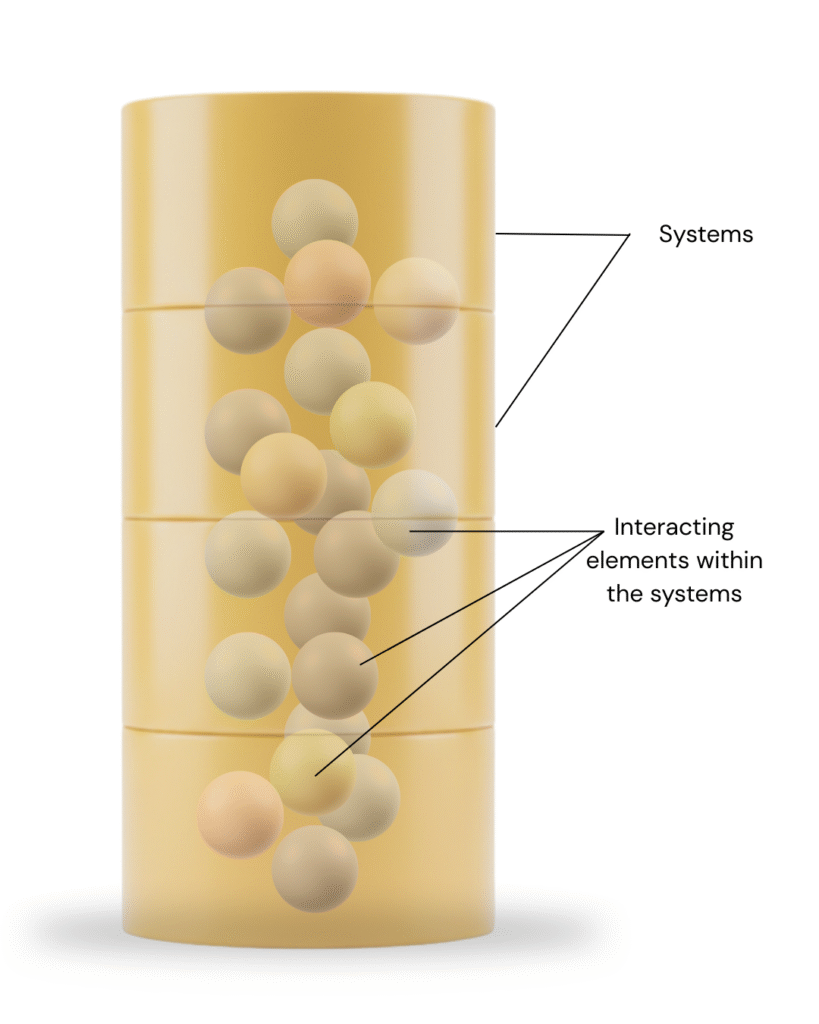
In Dioratikos, a system is understood as a bounded environment composed of interacting elements.
These elements may include:
individuals
roles or functions
decision rights
incentives and pressures
explicit and implicit rules
constraints and trade-offs
Over time, their interaction stabilises into recognisable structures.
Naming as intervention
Dioratikos holds one governing principle:
Naming is the intervention.
Naming does not reorganise a system.
It does not correct behaviour or resolve tension.
It exposes the pattern that has been operating without language.
Once exposed, systems gain the ability to choose how they respond.
What Dioratikos is not
Dioratikos is not:
- a framework
- a methodology
- a toolkit
- a consulting model
- a therapeutic approach
- a change programme
It does not prescribe action.
It renders systems intelligible.
Dioratikos exists because many systemic failures persist not from lack of effort or intelligence, but from operating without visibility of the pattern organising behaviour.
Systems do not become different by intention.
They become different when they are seen.
Dioratikos is written for readers interested in how systems organise behaviour, not for those seeking advice, tools, or personal guidance.