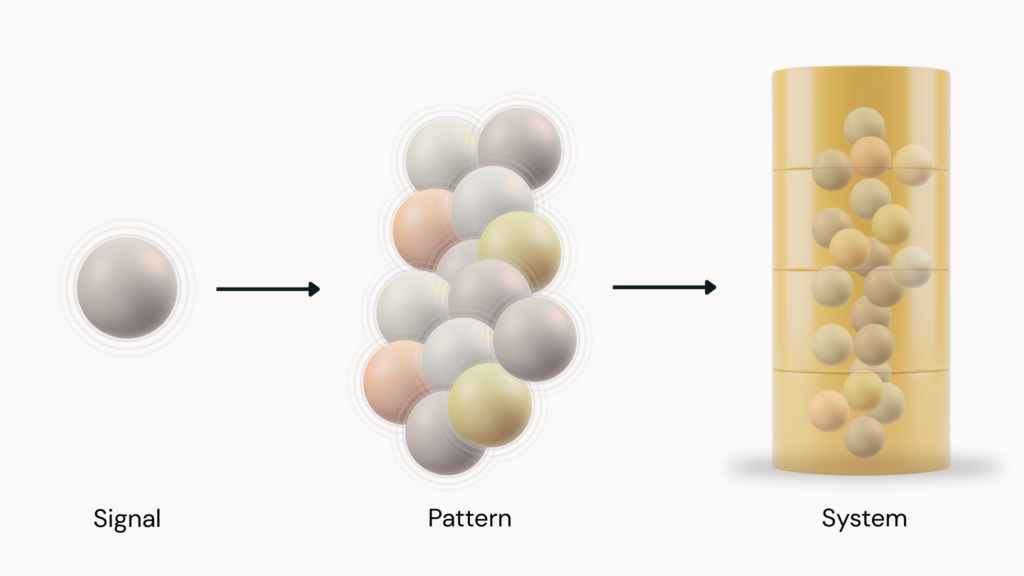
The Dioratikos Model describes how patterns operate within and across systems.
It provides a way to locate:
The model is not a framework for action.
It is a structure for perception.
Dioratikos does not analyse individuals, roles, or organisations as primary units.
Its primary unit of analysis is the pattern.
A pattern is a stable configuration of relationships, incentives, constraints, and responses that persists across time.
Individuals and organisations are sites where patterns express themselves, not the source of the pattern itself.
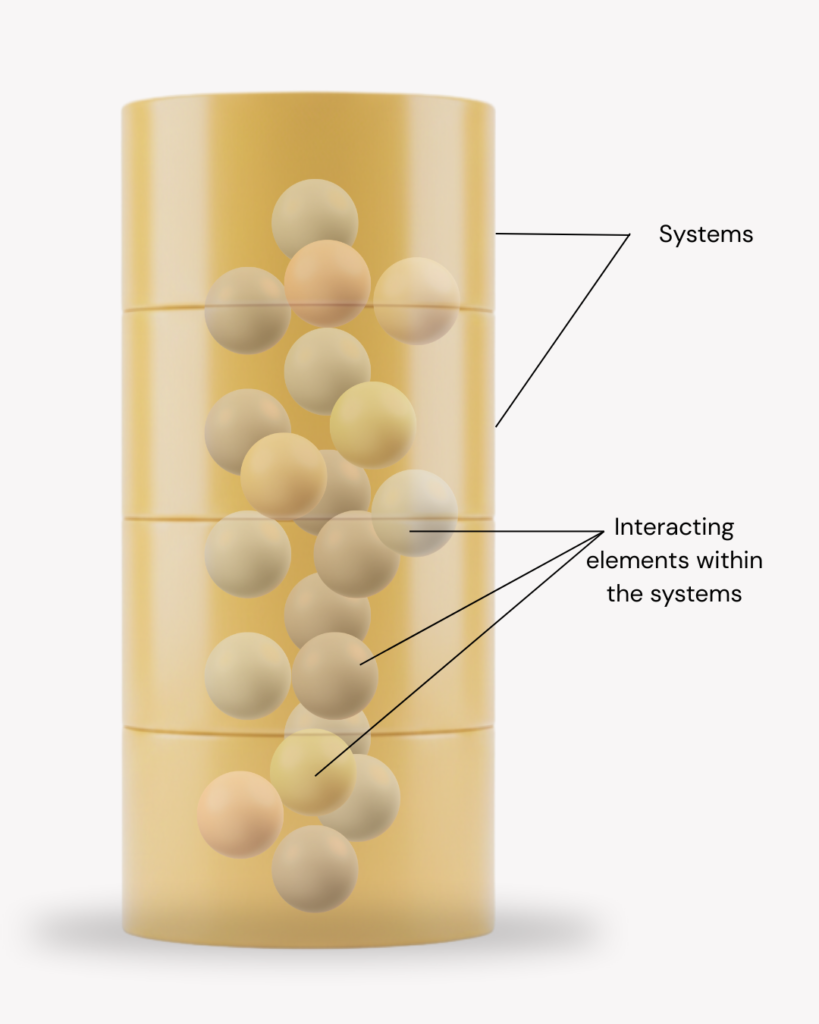
Systems exist at multiple scales simultaneously.
An individual exists within family systems, cultural systems, economic systems, and internal identity systems.
An organisation exists within markets, regulatory environments, histories, and social norms.
Dioratikos treats systems as nested environments, not isolated containers.
Patterns at one scale influence and constrain patterns at another.
Individuals are not single units inside systems. They are multi-system actors shaped simultaneously by role, relationship, incentive, identity, and consequence.
Behaviour changes not because the individual is inconsistent, but because the systemic context changes.
Dioratikos accounts for this by observing how the same pattern expresses differently across systems.
This prevents personalisation of structural effects.
The model distinguishes between three levels of observation.
A signal is a visible disturbance.
It may appear as tension, conflict, confusion, fatigue, delay, or inconsistency.
Signals draw attention, but they do not explain themselves.
A pattern is the organising logic behind repeated signals.
It explains:
Patterns are stable even when surface conditions change.
A system is the environment that sustains the pattern.
It includes:
Patterns persist because the system continues to make them viable.
The Dioratikos Model holds that visibility precedes choice.
Naming a pattern does not alter the system.
It alters what can be seen.
Once a pattern is named:
This is the only intervention the model claims.
Structural visibility requires distance.
Dioratikos positions the observer outside the system long enough to recognise what cannot be seen from within it.
This distance is not emotional disengagement.
It is removal from consequence, role, and loyalty.
Without this repositioning, patterns collapse into interpretation.
The Dioratikos Model:
The Dioratikos Model does not:
Those choices remain with the system.
This model underpins:
Its function is to make systems legible before action is taken.